Is Your Septic Company Website Producing Calls or Just Taking Up Space?
Most septic websites look fine but produce 1-3 calls per month. Run this self-audit to find out if your site is costing you jobs every single week.
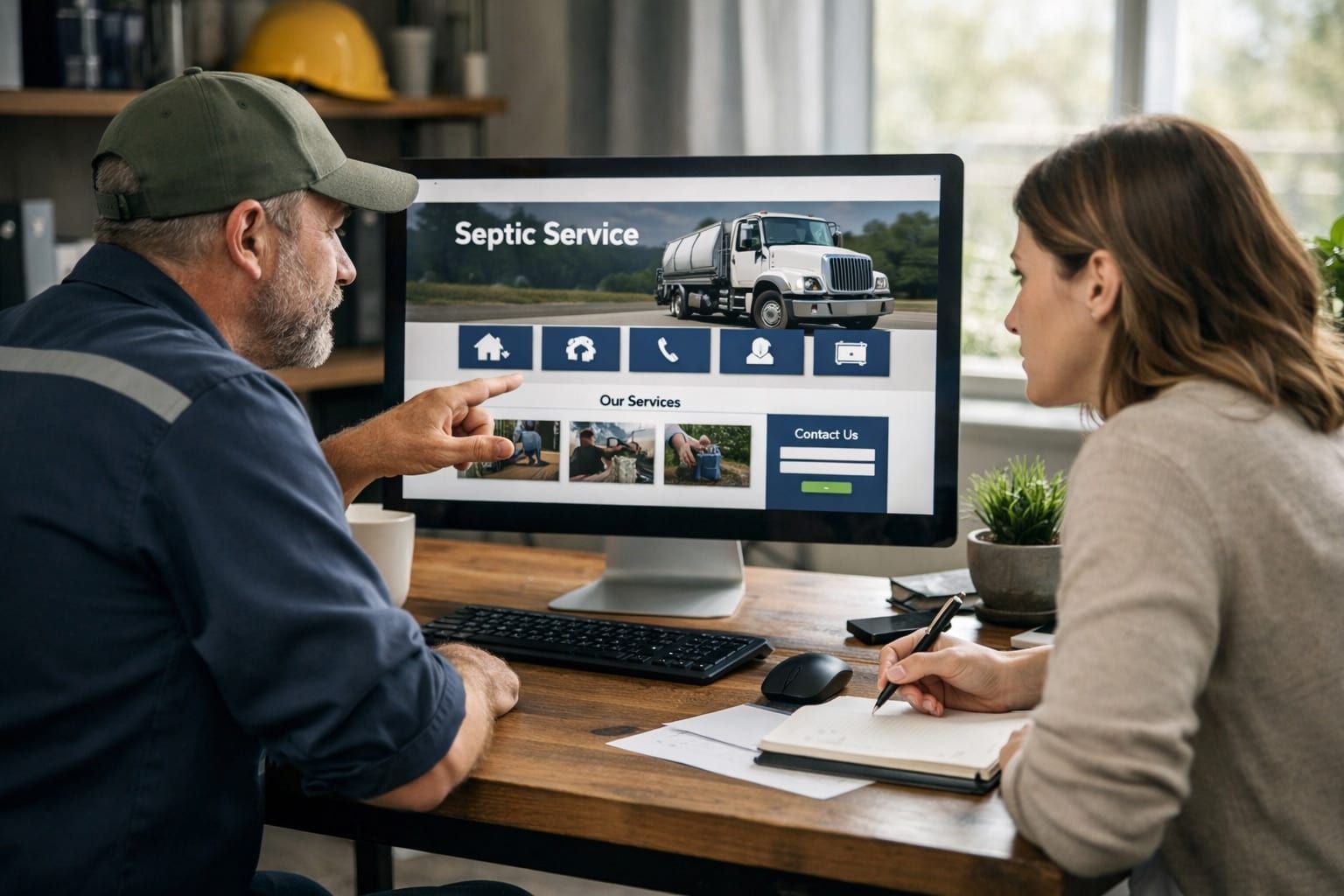
Pull up your septic company's website on your phone right now. Time how long it takes to load. Look at the first thing a visitor sees. Ask yourself: if I were a homeowner with sewage backing up into my bathroom, would this page make me call this company in the next 30 seconds?
If the answer is anything other than an immediate yes, your website is costing you money every single day. Not in hosting fees. In lost jobs.
The Free Self-Audit: 7 Questions
Go through these one by one. Be honest. Each "no" is probably costing you 2-4 calls per month.
1. Does your site load in under 3 seconds on mobile?
Test it at PageSpeed Insights (free, from Google). If your mobile score is below 50, you have a problem. Google has confirmed that 53% of mobile visitors leave a site that takes longer than 3 seconds to load. For septic emergencies, that number is probably higher. Nobody with a sewage backup is waiting for your slider to animate.
Most septic company websites we audit score between 25-40 on mobile. The site works fine on the desktop in your office. But 70-80% of your visitors are on their phone, standing in their yard, staring at a wet spot.
2. Is your phone number visible without scrolling?
On mobile, the phone number should be in the top bar, tappable, and large enough to hit with a thumb. On desktop, top-right corner, impossible to miss. If a visitor has to scroll down or navigate to your contact page to find your number, you're losing emergency calls. This one fix alone can increase calls by 20-30%.
3. Do you have a page for every major service?
Septic pumping, septic repair, septic installation, septic inspection, drain field repair, grease trap service. Each of those services needs its own page with unique content. A single "Services" page with bullet points gives Google nothing to rank. A dedicated "Septic Installation in [County]" page can rank for that exact search. This is the difference between showing up for 5 keywords and showing up for 50.
4. Do you have location-specific pages?
If you serve 3 counties and 15 towns, you should have pages targeting those areas. "Septic repair in Henderson County." "Septic pumping in [Town Name]." These pages don't need to be long. 300-500 words of unique content, your service details for that area, and a clear call to action. Without them, you're relying on Google to guess that you serve those areas. Google doesn't guess. Google reads pages.
5. Do you have more than 5 pages total?
The average septic company website has 5 pages: Home, About, Services, Gallery, Contact. That gives Google 5 chances to rank you for something. Your competitor who has 40 pages (services, locations, blog posts) has 40 chances. It's a numbers game, and most septic companies are playing it with one hand tied behind their back.
6. Are your Google reviews visible on the site?
Social proof closes deals. If you have 60+ Google reviews, those should be on your homepage, your service pages, and anywhere a visitor might hesitate. A homeowner choosing between two septic companies will pick the one with visible, recent, positive reviews nearly every time. If your reviews aren't on your website, you're making people leave your site to go check Google. Some of them won't come back.
7. Is there a clear call to action on every page?
Every single page should tell the visitor what to do next. "Call now for same-day service." "Request a free estimate." "Schedule your pump-out today." Not buried at the bottom. At the top, in the middle, and at the bottom. People don't read web pages. They scan. If the call to action isn't where their eyes land, it doesn't exist.
Scoring Your Audit
- 7 out of 7: Your site is in good shape. Focus on traffic (SEO and ads).
- 4-6 out of 7: You're leaving jobs on the table every month. The fixes aren't hard but they'll have an immediate impact.
- 0-3 out of 7: Your website is actively hurting your business. Every dollar you spend driving traffic to it is partially wasted because the site can't convert visitors into calls.
What a Website That Produces Jobs Looks Like
The septic companies booking 15-25+ calls per month from their website share the same traits:
- Mobile load time under 2 seconds
- Phone number in a sticky header on every page
- 30-60+ pages covering services and locations
- Reviews embedded from Google, updated automatically
- Clear, specific calls to action that match the page content
- Photos of their actual work, not stock images of green lawns
None of this is flashy. None of it requires a $20,000 custom design. It requires someone who understands that a septic website's job is to convert searchers into callers, period. Not to win design awards. Not to impress other web designers.
The Real Cost of a Bad Website
Let's say your current site gets 400 visitors per month (common for a septic company with basic SEO). At a 1% conversion rate (typical for a slow, poorly structured site), that's 4 calls. At a 5% conversion rate (achievable with the fixes above), that's 20 calls. Same traffic. 16 extra calls. If even half of those turn into jobs averaging $1,500, that's $12,000 per month you're leaving on the table.
A website rebuilt for conversions typically pays for itself within the first month. Not because of magic. Because a site that loads fast, ranks well, and makes it easy to call simply produces more calls from the same traffic. That's not theory. That's what we see happen every time.
If your audit score was below 7, check out how we build septic company websites that actually produce calls. You own everything we build. No hostage situations. No monthly fees for access to your own site.