Epoxy vs. Polyaspartic Coatings: An Honest Side-by-Side
Epoxy or polyaspartic for your garage floor? We compare cure time, durability, cost, and UV stability so you can pick the right coating without the sales spin.
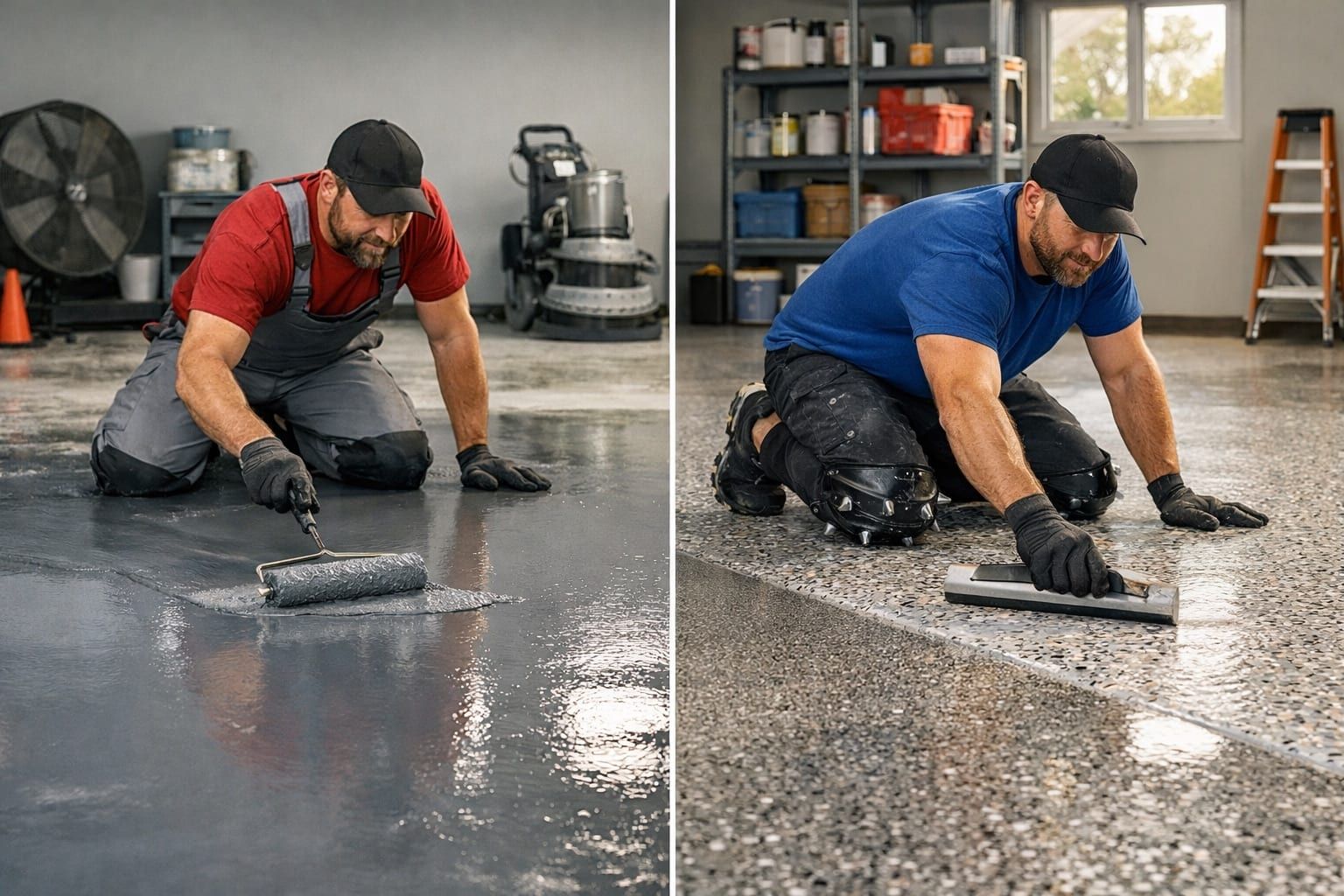
Every coating company has an opinion on this. Some push epoxy because it's what they've always used. Others have gone all-in on polyaspartic because the margins are better and the install is faster. Neither side is lying -- but neither is giving you the full picture. Here's the honest breakdown.
What's the Actual Difference?
Epoxy is a two-part thermosetting resin. You mix a resin with a hardener, and a chemical reaction creates an extremely hard, bonded surface. It's been used on industrial and commercial floors since the 1950s.
Polyaspartic is a type of polyurea coating -- a newer chemistry (developed in the 1990s) that cures through a different reaction. It's faster, more flexible, and UV-stable out of the box.
They're both applied to concrete. They both look great with decorative flake. But the similarities end there.
Cure Time: This Is the Big One
A traditional epoxy system needs 24-72 hours between coats, and your garage is out of commission for 3-7 days total. In colder temps, that timeline stretches even further.
Polyaspartic cures in 1-4 hours per coat. A skilled crew can do a full multi-coat system in a single day, and you can park on it the next morning. For a garage you actually need to use, that's a massive advantage.
Durability and Abrasion Resistance
Both systems are tough. But they're tough in different ways.
- Epoxy is extremely hard -- great for heavy static loads, toolbox casters, jack stands. But that hardness also means it can be more brittle. Impact from a dropped wrench can chip it.
- Polyaspartic has more flexibility. It handles impact better and resists abrasion well, but it's slightly softer. For residential garages, the difference is negligible. In a heavy commercial shop, epoxy might edge it out for wear resistance.
Hot-tire pickup is where polyaspartic wins decisively. Epoxy softens slightly under heat, and hot tires fresh off the highway can stick to it and pull up the coating. Quality polyaspartic systems don't have this problem.
UV Stability
Standard epoxy yellows and ambers when exposed to UV light. If your garage door is open a lot or you're coating an outdoor patio, epoxy will discolor within 6-12 months.
Polyaspartic is inherently UV-stable. No yellowing, no ambering. The color and clarity stay consistent for the life of the coating. If your space gets any sunlight, this matters.
Cost Comparison
Here's where it gets interesting. Material cost for polyaspartic is 20-40% higher than epoxy. But labor is often lower because the install takes one day instead of three. When you add it all up:
- Epoxy system (installed): $4-$7 per sq ft
- Polyaspartic system (installed): $6-$10 per sq ft
The premium for polyaspartic is real but not dramatic -- usually $800-$1,500 more on a standard two-car garage. Many homeowners decide that's worth it for the one-day install and UV stability alone.
The Hybrid Approach
A lot of top-tier coating companies now use a hybrid system: epoxy as the base/build coat (for thickness and adhesion) with a polyaspartic topcoat (for UV stability, chemical resistance, and fast cure). You get the best of both chemistries.
This is what most of the serious residential coating companies have standardized on. If a contractor offers this as their default system, that's a good sign they know what they're doing.
Which Should You Pick?
For most residential garage floors, polyaspartic or a hybrid system is the better choice. The one-day install, UV stability, and hot-tire resistance make it the practical winner for spaces that get daily use.
For commercial or industrial floors that don't see sunlight and need maximum abrasion resistance at the lowest cost, a full epoxy system still makes a lot of sense.
For patios, pool decks, and outdoor concrete, polyaspartic is the only real option. Epoxy will yellow and deteriorate under UV exposure.
The Real Differentiator
Here's the thing most coating companies won't tell you: the product matters less than the prep. A $10/sq ft polyaspartic system slapped onto poorly prepped concrete will fail faster than a $5/sq ft epoxy applied after proper diamond grinding. The contractor's process matters more than the chemistry they use.
If you're a coating contractor looking to get your expertise in front of the homeowners searching these exact questions, SEO for epoxy coating companies is how you make that happen. Ranking for buyer-intent keywords like "epoxy vs polyaspartic" is one of the highest-ROI moves in this industry. You can also learn more about the epoxy and coatings niche we serve.